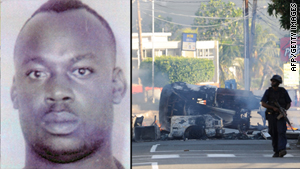
Osama bin Laden, the face of terror, killed in Pakistan

Osama bin Laden used the fruits of his family's success -- a personal fortune estimated in the hundreds of millions of dollars -- to help finance al Qaeda in its quest for a new pan-Islamic religious state.

CNN

The Saudi-born zealot commanded al Qaeda, a terrorist organization run like a rogue multinational firm, experts said, with subsidiaries operating secretly in dozens of countries, plotting terror, raising money and recruiting young Muslim men -- even boys -- from many nations to its training camps in Afghanistan.


Bin Laden and his terrorist network were behind the September 11, 2001, attacks on the United States and are linked to others around the world.

The enormity of the destruction in the 9/11 attacks -- the World Trade Center's towers devastated by two hijacked airplanes, the Pentagon heavily damaged by a third hijacked jetliner, a fourth flight crashed in rural Pennsylvania, and more than 3,000 people killed -- gave bin Laden a global presence.

His death early Monday in Pakistan ended a nearly 10-year long manhunt for one of the world's most-wanted men.

Even before September 11, 2001, bin Laden was already on the FBI's Ten Most Wanted Fugitives list.

He had been implicated in a series of deadly, high-profile attacks that had grown in their intensity and success during the 1990s.

They included a deadly firefight with U.S. soldiers in Somalia in October 1993, the bombings of two U.S. embassies in East Africa that killed 224 in August 1998, and an attack on the USS Cole that killed 17 sailors in October 2000.

Bin Laden eluded capture for years, once reportedly slipping out of a training camp in Afghanistan just hours before a barrage of U.S. cruise missiles destroyed it.

On September 11, sources said, the evidence immediately pointed to bin Laden. Within days, those close to the investigation said they had their proof.

Six days after the attack, President George W. Bush made it clear Osama bin Laden was the No. 1 suspect.

"I want justice," Bush said. "There's an old poster out West that said, 'Wanted, dead or alive.'"

Bin Laden was born in the kingdom of Saudi Arabia in 1957, the 17th of 52 children in a family that had struck it rich in the construction business.

His father, Mohamed bin Laden, was a native of Yemen, who immigrated to Saudi Arabia as a child. He became a billionaire by building his company into the largest construction firm in the Saudi kingdom.

As Saudi Arabia became flush with oil money, so, too, did the bin Laden family business, as Osama's father cultivated and exploited connections within the royal family.

One of the elder bin Laden's four wives -- described as Syrian in some accounts -- was Osama's mother. The young bin Laden inherited a share of the family fortune at an early age after his father died in an aircraft accident.

The bin Ladens were noted for their religious commitment. In his youth, Osama studied with Muslim scholars. Two of the family businesses' most prestigious projects also left a lasting impression: the renovations of mosques at Mecca and Medina, Islam's two holiest sites.

As a young man attending college in Jeddah, bin Laden's interest in religion started to take a political turn. One of his professors was Abdullah Azzam, a Palestinian scholar who was a key figure in the rise of a new pan-Islamic religious movement.

Azzam founded an organization to help the mujahedeen fighting to repel the Soviet Union's invasion of Afghanistan in 1979.

Bin Laden soon became the organization's top financier, using his family connections to raise money. He left as a volunteer for Afghanistan at 22, joining the U.S.-backed call to arms against the Soviets.

He remained there for a decade, using construction equipment from his family's business to help the Muslim guerrilla forces build shelters, tunnels and roads through the rugged Afghan mountains, and at times taking part in battle.

In the late 1980s, bin Laden founded al Qaeda, Arabic for "the base," an organization that CNN terrorism analyst and author Peter Bergen says had fairly prosaic beginnings. One of its purposes was to provide documentation for Arab fighters who fought against the Soviets in Afghanistan, including death certificates.

Al Qaeda, under bin Laden's leadership, ran a number of guesthouses for these Arab fighters and their families. It also operated training camps to help them prepare for the fight against the Soviets.

In the early 1990s, with the disintegration of the Soviet Union, bin Laden turned his sights on the world's remaining superpower -- the United States. War-hardened and victorious, he returned to Saudi Arabia following the Soviet retreat from Afghanistan.

In a 1997 CNN interview, bin Laden declared a "jihad," or "holy war," against the United States.

The Iraqi invasion of Kuwait provided the next turning point in Osama bin Laden's career.

When the United States sent troops to Saudi Arabia for battle against Iraq in the Persian Gulf War, bin Laden was outraged. He had offered his own men to defend the Saudi kingdom but the Saudi government ignored his plan.

He began to target the United States for its presence in Saudi Arabia, home to the Muslim holy sites of Mecca and Medina. With bin Laden's criticisms creating too much friction with the Saudi government, he and his supporters left for Sudan in 1991.

There, according to U.S. officials, al Qaeda began to evolve into a terror network, with bin Laden at its helm. Tapping into his personal fortune, bin Laden operated a range of businesses involved in construction, farming and exporting.

Although the U.S. government was unaware of it at the time, bin Laden was already actively working against it.

According to court testimony, he sent one of his top lieutenants, Mohammed Atef, to help train Somalis to attack U.S. peacekeeping troops stationed there. Bin Laden would later hint, during an interview with CNN, of his involvement in the deaths of 18 U.S. Army Rangers in 1993 in Mogadishu.

Also in 1993, terrorists bombed the World Trade Center in New York, killing six and wounding hundreds. Eventually, bin Laden would be named along with many others as an unindicted co-conspirator in that case. The mastermind of the attack, Ramzi Yousef, would later be revealed to have close ties to al Qaeda.

In 1996, bin Laden took his war against the United States a step further. By then, he had been stripped of his Saudi citizenship and forced by Sudanese officials, under pressure from the United States, to leave that country. He returned to Afghanistan where he received harbor from the fundamentalist Taliban, who were ruling the country.

By then, the United States had begun to recognize a growing threat from bin Laden, citing him as a financier of terrorism in a government report.

According to reports, however, the U.S. government passed up a Sudanese government offer to turn over bin Laden, because at the time it had no criminal charges against him. The Saudis, according to an interview with their former intelligence chief in Time magazine, also declined to take custody of bin Laden.

In Afghanistan in 1996, bin Laden issued a "fatwa," or a religious order, entitled "Declaration of War Against Americans Who Occupy the Lands of the Two Holy Mosques."

"There is no more important thing than pushing the American occupier out," decreed the fatwa, which praised Muslim youths willing to die to accomplish that goal: "Youths only want one thing, to kill (U.S. soldiers) so they can get to Paradise."

In his first interview with Western media in 1997, bin Laden told CNN that the United States was "unjust, criminal and tyrannical."

"The U.S. today, as a result of the arrogant atmosphere, has set a double standard, calling whoever goes against its injustice a terrorist," he said in the interview. "It wants to occupy our countries, steal our resources, impose on us agents to rule us."

In February 1998, he expanded his target list, issuing a new fatwa against all Americans, including civilians.

They were to be killed wherever they might be found anywhere in the world, he decreed. This new fatwa announced the creation of the "The World Islamic Front for Jihad against the Jews and the Crusaders" and was co-signed by Dr. Ayman al-Zawahiri, head of Egypt's al-Jihad terrorist group.

Six months later, explosions destroyed the U.S. embassies in Kenya and Tanzania, killing 224 people and injuring 4,000 more.

U.S. prosecutors later indicted bin Laden for masterminding those attacks.

By the time three hijacked airliners struck the World Trade Center and the Pentagon, symbols of the U.S. business and military might, bin Laden's terror network had become global in its reach.

The organization soon became America's prime target in Bush's war against global terrorism. Bin Laden, its founder, became the most-wanted man in the world.

Then-U.S. Secretary of State Colin Powell explained al Qaeda's network this way: "Osama bin Laden is the chairman of the holding company, and within that holding company are terrorist cells and organizations in dozens of countries around the world, any of them capable of committing a terrorist act."

"It's not enough to get one individual, although we'll start with that one individual," Powell said.

In statements released from his hideouts in Afghanistan after September 11, bin Laden denied al Qaeda was responsible for the attacks.

A videotape of bin Laden later obtained and released by the U.S. government, however, showed him saying he knew the September 11 attacks were coming, chuckling and gloating about their toll. Even with his knowledge of the construction trade, he said with a smile, he did not expect the twin towers of the World Trade Center to collapse completely.

Speaking in an earlier video recording that was first broadcast over the Arabic-language television network Al-Jazeera, bin Laden said America is "filled with fear from the north, south, east and west. Thank God for that."

"These events have split the world into two camps -- belief and disbelief," he said. "America will never dream or know or taste security or safety unless we know safety and security in our land and in Palestine."

Bin Laden had taken advantage of his time in Afghanistan, cementing his ties to the Taliban.

He was particularly close to Taliban leader Mullah Mohammed Omar. He built a mansion in Kandahar but spent most of his time on the move around the country, according to intelligence sources.

Al Qaeda had a network of training camps and safe houses where recruits from around the world were brought for combat and weapons training and indoctrination.

As long as the Taliban ruled Afghanistan, bin Laden, his four wives and more than 10 children were able to avoid capture.

Before September 11, the Afghan government refused U.S. requests to turn over bin Laden. "Osama's protection is our moral and Islamic duty," one Taliban official was quoted as saying in July 2001.

As the United States bombing campaign helped the Afghan opposition drive the Taliban from power, however, bin Laden's days were numbered.

The reward on his head grew to $25 million. Countless leaflets advertising the bounty were dropped from U.S. airplanes, which flew with impunity over Afghan skies.

"We're hunting him down," Bush said on November 19, 2001. "He runs and he hides, but as we've said repeatedly, the noose is beginning to narrow. The net is getting tighter."

But he eluded U.S. and allied authorities during the war in Afghanistan, vanishing in December 2001, apparently fleeing during the intensive bombing campaign in the rugged Tora Bora region near the border with Pakistan.

"He's alive or dead. He's in Afghanistan or somewhere else," then-Defense Secretary Donald Rumsfeld said in April 2002 when asked about bin Laden's whereabouts.

No more videos showing bin Laden were released during the spring and summer of 2002 and there was speculation that he may have died during U.S. bombing raids in Afghanistan.

But audiotapes released in October and November 2002 and broadcast on Al-Jazeera were allegedly were from him. U.S. government experts analyzed the tapes and said the voice on the tapes was almost certainly bin Laden's.

On February 11, 2002, a new audio message purportedly from bin Laden called on Muslims around the world to show solidarity against U.S.-led military action in Iraq.

The tape was broadcast on Al Jazeera, which originally denied its existence. The voice on tape added that any nation that helps the United States attack Iraq, "(Has) to know that they are outside this Islamic nation. Jordan and Morocco and Nigeria and Saudi Arabia should be careful that this war, this crusade, is attacking the people of Islam first."

Days later, U.S. government reports suggest that bin Laden had survived sustained bombing and could be near the border of Afghanistan and Pakistan.

Then, in May 2002, Taliban leader Mullah Mohammed Omar is quoted in a Saudi-owned publication, "Sheikh Osama is still alive, praise God." A Russian newspaper publishes a similar report likewise quoting Omar, saying, "Osama helped us during the war with the (Soviets), he would not leave us now."

Abdel-Bari Atwan, the editor of the London-based Al-Quds Al Arabi newspaper, said in July of that year that bin Laden was in good health, despite being wounded in an attack on his base in Afghanistan the previous December. Atwan said then that bin Laden's followers had told him that the al Qaeda leader would not make more video statements until his group launched another attack on the United States.

That appeared to prove prescient, as there were no further attacks on U.S. soil in subsequent years -- though there were several high-profile attempts, purportedly linked to al Qaeda -- and few signs of bin Laden.

Muslim clerics in Spain turned the tables on bin Laden in March 2005, issuing the first fatwa against the terrorist leader. The Islamic edict called him an apostate and urged other Muslims to denounce him.

More details about bin Laden came out in October 2009, in the form of a book written by one of his wives and sons titled, "Growing Up bin Laden: Osama's Wife and Son Take Us Inside Their World."

A few months later, the U.S. government admitted a "lack of intelligence" on his whereabouts -- suspecting that he could be in Afghanistan or Pakistan.

But he reappeared on the world's radar in January 2010, with the release of two audiotapes released in the span of a week.

In the first, he purportedly claimed responsibility for the alleged Christmas Day attempt by Nigerian national Umar Farouk AbdulMuttallab to blow up a Northwest Airlines plane as it neared Detroit, Michigan, from Amsterdam, Netherlands. In that tape, the voice -- thought to be bin Laden's -- warned the United States of more attacks.

Days later, Al Jazeera released an audiotape purportedly from bin Laden in which he condemned the United States and other industrial nations for causing climate change.

Then, in January of this year, a speaker claiming to be the terrorist mastermind warned French troops to leave Afghanistan -- or else two French journalists abducted by militants there could be killed.

The speaker thought to be bin Laden said on the audiotape, which also aired on Al Jazeera, that France's alliance with the United States will prove costly.

One U.S. counterterrorism official told CNN at the time that the tape "sends a chill up your spine," as it refers to "a couple of human beings whose lives are at stake."

For several months before that last tape's release, however, U.S. officials had received specific information about where bin Laden may have been hiding in Pakistan, according to President Barack Obama.

On Sunday, the president said he ordered an operation -- carried out by a handful of U.S. troops -- to get bin Laden in Pakistan. The al Qaeda leader resisted and was killed in an ensuing firefight, and U.S. forces took custody of his body. He was later buried at sea, with one U.S. official saying his body was handled in the Islamic tradition.

"His demise should be welcomed by all who believe in peace and human dignity," Obama said in a speech announcing bin Laden's death. "Justice has been done."
Read More

'Thorn from Jesus's crucifixion crown' goes on display at British Museum

It was plundered in the Fourth Crusade, sold to French royalty and has spent the past 200 years in safekeeping at a British public school.

Now a relic claimed to be a thorn from Jesus's crown is to go on display at the British Museum.

And while no one can doubt the item's rich history, there is less evidence to support the claims of its provenance.

The Crown of Thorns is said to have been seized from Constantinople, the imperial capital of the Roman Empire, in the Fourth Crusade - around AD 1200 - and was later sold to King Louis IX of France while he was in Venice.

King Louis kept the religious relic in the specially-built Saint Chapel and thorns were broken off from the crown and given to people who married into the family as gifts.

The thorn at Stonyhurst College - a 400-year-old Jesuit boarding school - was said to have been given to Mary Queen of Scots who married into the French royal family and she took it with her to Holyrood in Edinburgh.

And following her execution in 1587, it was passed from her loyal servant, Thomas Percy, to his daughter, Elizabeth Woodruff, who then gave it to her confessor - a Jesuit priest - in 1600.

The Jesuits brought it with them to the college and it has been kept at the Ribble Valley college ever since.

Read More

The Satanists of Ash Tree Close: 'Evil' paedophile found guilty of running sex cult from cul-de-sac in seaside village


The leader of a Satanic sex cult is facing a lengthy jail sentence after being found guilty of multiple counts of rape and child abuse.

Colin Batley, 48, exercised absolute control over his sect in a seaside cul-de-sac – abusing and exploiting helpless children as ‘sex toys’ for more than a decade.

He was found guilty yesterday of 35 sex offences against children and young adults. Yet social services were alerted to Batley’s child abuse in 2002 – and took no action.

As a consequence, the former Tesco security guard was allowed to continue ‘preying on the young and vulnerable’ for a further eight years – with the full support of wife Elaine.

At their semi in Kidwelly, South Wales, he would dress in hooded robes, chant before an altar and then orchestrate or participate in group sex with his female followers, including Jacqueline Marling and Shelly Millar.

One helpless girl was ‘initiated’ when she was just 11 and threatened with death by ‘cult assassins’ if she did not comply. At least two of his young victims gave birth as a result of the ‘systematic and prolonged abuse’.

Yesterday at Swansea Crown Court, Marling, 42, and Elaine Batley, 47, were found guilty of five counts including sexual activity and indecency towards children. Millar, 35, was found guilty of two similar charges. Another woman, Sandra Iveson, was found not guilty of gross indecency.

Those found guilty will be sentenced tomorrow and face ‘substantial’ jail terms.

Colin Batley’s home was a typical semi in a typical cul-de-sac. But to the stream of visitors who trooped through the front door – especially on Sunday nights – it was the Temple.

In the lounge, a white cloth would be draped over a table to form an altar with candles and burning incense; nearby were tanks full of snakes and Satanic symbols. Those present would put on hooded robes and wear upside-down crucifixes.

There would be chanting, which would always end in group sex.

Children, boys and girls as young as 11, were also ‘initiated’ – repeatedly sexually abused in other words – during ‘Black Masses’ at Batley’s home. There were at least five victims that we know of, but police believe there could have been many more.

Yet these vile activities did not disturb the neighbours. Why? Because they were involved too. They lived in houses next to or opposite each other on the outskirts of Kidwelly (population 3,000) near Carmarthen.

For more than a decade Clos Yr Onnen, Welsh for Ash Tree Close, was possibly the most depraved street in Britain. The proof was there, in black and white, on the charge sheet at Swansea Crown Court where Batley, his bisexual wife Elaine and their accomplices stood trial for a sickening catalogue of crimes. All of them perpetrated by culprits living in the same road; perhaps the single most shocking fact of all.

This disturbing story begins not in Wales, however, but more than 200 miles away in East London. Batley, from Shoreditch, had a string of jobs including work as a Tesco security guard and on a fruit-and-vegetable stall. He also bred rottweiler dogs and Siamese cats. His outwardly mundane existence, we now know, masked a sinister private life.

He and his wife had been dabbling with the occult ever since they were married 30 years ago and were obsessed with Aleister Crowley, the most notorious Satanist of the 20th century, the self-styled ‘Great Beast’. One of Crowley’s publications, the Book of the Law, includes the passage: ‘Let all chaste women be despised. Sex with anyone is not just permissible but to be encouraged.’ And this: ‘Some of the most passionate and permanent attachments have begun with rape. Rome was founded thereon.’

Apart from anything else, the Book of the Law provided justification for the couple’s own ‘open marriage’.

Batley had sent a photo of his wife to the Readers’ Wives section of a pornographic magazine and this had led to them meeting ‘others for group activities’, the jury was told. They included former dental nurse Jacqueline Marling and prostitute Shelly Millar, who both joined Batley’s occult ‘circle’.

They were given matching tattoos of the Eye of Horus, the Egyptian falcon god depicted pecking out the eyes of Christ in Crowley’s works, and addressed Batley as ‘My lord’ (police found him listed under this name on Millar’s mobile phone).

Such was Batley’s control over his wretched ‘coven’ that they had to pay him 25 per cent of their income.

Every time Millar entertained a client, she would send Batley a text message to tell him how much she had been paid. She had sex with more than 3,000 clients over a two-year period, making about £2,000 a month, a quarter of which went to him. It explained how Batley, officially unemployed, could afford a £45,000 caravan and frequent holidays abroad.

Read more: http://www.dailymail.co.uk/news/article-1364583/Evil-paedophile-guilty-running-cul-sac-sex-cult-seaside-home.html#ixzz1G9lF8w9B

Batley would later claim that he moved to Wales for health reasons – to escape the smog. A claim rather undermined by the fact that his coven also relocated to the principality. Police believe there was another reason for the exodus; they suspect that other members of the cult – who have not been identified – were based in Wales.

The first East Londoner to arrive in Kidwelly was twice-married mother of four Sandra Iveson in 1995. The following year, the Batleys moved in. Two years later, Marling became their next-door neighbour and Millar, 35, an unmarried mother of two who was brought up a Catholic, completed the set.

Did other residents have any inkling of the kind of people that were now living among them? Well, with hindsight, there were a few small clues.

John Wheatland and his wife Marion, both in their seventies, couldn’t help but notice how Colin Batley was ‘over at Shelly’s all the time’.

On another occasion, the Wheatlands encountered Millar and another woman kissing and touching each other in the supermarket. Yet they could not have imagined the extent of what was really going on behind the closed curtains of the so-called Temple. During occult gatherings it became the set of a horror movie.

Batley, in a hooded robe, would read out extracts from the Book of the Law, which had been typed out and laminated by his wife. Hanging above him on the wall was a gold ceremonial dagger and sitting menacingly nearby were his two rottweilers, Tutankhamun and Sekhet.

One young victim told how Batley introduced her to the cult by raping her when she was 11, telling her that having sex with him was a ‘test’ and if she did not pass she would go to ‘the Abyss’. The victim, now in her twenties, told the court: ‘I did not want him to do what he was doing, but I did not have a choice because what Colin said happened. What Colin said went.’

The abuse continued for years. As a teenager she became pregnant by Batley, who prevented her from having an abortion saying that babies belonged to the cult and not to their mothers.

Another victim, now in her thirties, said she was forced to have sex with Batley when she was 15. She was also ordered to perform sex acts on his wife and other men and women. ‘I was told I’d be killed if I didn’t become part of the cult,’ she said. ‘Colin Batley had a gun and brought it to meetings. I was so scared I just did what I was told. I was in the living room at his home and he told me there would be an initiation. I was called upstairs. Elaine was there. He would just snap his fingers and say, “Strip”.’

She said that on one occasion when she was 16, she was made to have sex with a boy of 15 – as Marling filmed them.

The girl was told she would be murdered by ‘cult assassins’ if she did not give in to Batley’s demands. Through a video link, she sobbed as she told how she was taken to other addresses by Batley where she had sex with other men. ‘I did it because I was told to by Colin.’ Another woman victim said she was recruited into the cult and became pregnant after becoming a ‘sexual plaything’ for the group. Batley ordered her not to abort her ‘occult child’.

One male victim said that, as a teenager, he was tricked into having sex with Batley’s wife.

The witness recalled how Batley promised to set him up with a girl and directed him to a dark bedroom. Once inside, he got into bed and then realised that the other person lying beside him was Elaine Batley.

One of the charges against Shelly Millar was that she seduced a boy of 15. Millar claimed he was 16, and that she was teaching him how to have sex as he had a new girlfriend ‘he wanted to impress’. She had sex with him twice in Batley’s caravan in Tenby. Batley, it emerged during the trial, had been reported to Carmarthenshire Social Services in 2002 by a concerned relative. She said Batley had been abused by his own father and that ‘history was about to repeat itself’.

The warning went unheeded, allowing Batley and his cult to prey on youngsters week after week, month after month for another eight years.

The Batleys had four children, one of whom, Damian, died of strangulation three years ago when a bizarre sex game went wrong. He was found hanging from his bedroom door at the family home and had been filming himself.

Finally, last year, one of Batley’s victims went to the police. It was one of the girls he had impregnated as a teenager. She said she feared he might target her own child.

Batley was tipped off about the police inquiry and, by the time he was arrested, had destroyed potential evidence. But officers found home-made films of two of his victims on his camcorder. Interviewed 11 times by detectives, he steadfastly maintained his innocence.

The jury did not believe him. They saw him for what he was – ‘an evil and manipulative sexual predator’ who had used the cult and ‘black magic’ as a cover for his own perverted ends.

Back in Kidwelly, there was relief at the verdicts. ‘I’m just glad they’ve all finally gone,’ said John Wheatland.

He spoke for everyone in Ash Tree Close.

Sex cult was inspired by 'the Great Beast'

The cult’s inspiration, Aleister ‘the Great Beast’ Crowley, believed himself to be a prophet of a new age of personal liberty, controlled by the ancient Egyptian god Horus.

He was a bisexual heroin addict whose doctrine for life was ‘Do What Thou Wilt’, advocating sexual promiscuity and prostitution.

Crowley was a frequenter of orgies and brothels, and contracted gonorrhea from a prostitute.

Born into a wealthy family in Leamington Spa, Warwickshire, he gained such notoriety during his lifetime that he was denounced in the press as ‘the wickedest man in the world’.

Crowley’s work has been cited as an influence by famous figures including Led Zeppelin guitarist Jimmy Page, who bought Crowley’s former home and set up an occult bookshop and publishing house which published some of his work.

Page once said: ‘I feel Aleister Crowley is a misunderstood genius of the 20th century because his whole thing was liberation of the person.’

SLEEPY TOWN SHOCKED BY PERVERTED SEX CULT

A handful of housing association homes in an overlooked cul-de-sac in sleepy Kidwelly is an unlikely location for a sex cult.

With its medieval castle, industrial museum and historic canal, the pretty seaside town tries hard to attract the tourist pound.

The first anyone heard of a satanic paedophile ring was when Colin Batley hit the national headlines last month.

Despite having lived in the community for years, the cult's inevitably low-key operation had gone completely unnoticed.

News of what had been going on under their noses for so long was greeted by many residents with disbelief, shock and unease.

Even today, few in the deeply conservative community were willing to do much more than express shock at revelations from the trial.

One man spoke of the anger at the way a group of 'outsiders' from London had stained the town's character.

'Nobody understands how so many of them could come down and all end up living in one place in the town,' he said.

'They must have planned it somehow. I don't think Kidwelly is to blame for what has gone on. They kept a very low profile.'
He said he preferred not to give his name because he felt the cult would still be operating in the area.

But Geraint Thomas, Kidwelly Town Council clerk, predicted that the community would quickly rise above its problems.

'The first we knew about this matter was when it was publicised in the newspapers. It is fair to say that on reading about it we were shocked and dismayed.

'This unfortunate matter has put Kidwelly on the map for wrong reasons as we are continuously endeavouring to promote the town of Kidwelly and its environment in a positive way.

'We view this matter as a one-off. Kidwelly is a safe and respectable place to live and visit for all ages.'


Daily Mail Reporter - Original Version
Read More

Protesters Stand Firm On Egypt's Streets


Thousands of protesters remain gathered in Egypt's capital as what has been called the "Day of Departure" draws to a close.

Demonstrators have pledged to stay on the streets of Egypt's cities until embattled leader Hosni Mubarak steps down.

The president of 30 years has said he will remain in control until September, when he will not stand for re-election.

Earlier, largely good-humoured crowds streamed into Cairo's Tahrir (Freedom) Square, the scene of earlier clashes between pro and anti-Mubarak supporters.

Tim Marshall, in Cairo, and Kat Higgins
Thousands of protesters remain gathered in Egypt's capital as what has been called the "Day of Departure" draws to a close.

:: Follow breaking developments here and LIVE at www.skynews.com/liveplus

Demonstrators have pledged to stay on the streets of Egypt's cities until embattled leader Hosni Mubarak steps down.

The president of 30 years has said he will remain in control until September, when he will not stand for re-election.

Earlier, largely good-humoured crowds streamed into Cairo's Tahrir (Freedom) Square, the scene of earlier clashes between pro and anti-Mubarak supporters.

Live Blog: Egypt Protests

Thousands of protesters have also gathered in Alexandria, Egypt's second-largest city.

The Egyptian prime minister has said the crowds in Tahrir Square will not be forced to leave and state television says the curfew has been shortened.

Meanwhile, an Egyptian reporter shot during the clashes earlier this week has died, becoming the first journalist to be killed in the political crisis.

Although the protests on Friday have been mainly peaceful there have been reports of fights breaking out and gunshots were heard north of the square at one point.

Earlier this week men from each side were seen throwing petrol bombs and rocks, and dishing out brutal beatings on the streets.

The New York Times reported that US officials are discussing plans for Mr Mubarak to step down immediately and hand power to a transitional government led by vice president Omar Suleiman and the army.

Mr Mubarak, 82, said yesterday he would have stepped down this week but feared chaos and the Islamist Muslim Brotherhood taking power.

In an interview with America's ABC News, the leader denied accusations that it was his hired thugs who had been stirring up the violence this week.

Thousands of protesters remain gathered in Egypt's capital as what has been called the "Day of Departure" draws to a close.

Demonstrators have pledged to stay on the streets of Egypt's cities until embattled leader Hosni Mubarak steps down.

The president of 30 years has said he will remain in control until September, when he will not stand for re-election.

Earlier, largely good-humoured crowds streamed into Cairo's Tahrir (Freedom) Square, the scene of earlier clashes between pro and anti-Mubarak supporters.

Thousands of protesters have also gathered in Alexandria, Egypt's second-largest city.

The Egyptian prime minister has said the crowds in Tahrir Square will not be forced to leave and state television says the curfew has been shortened.

Meanwhile, an Egyptian reporter shot during the clashes earlier this week has died, becoming the first journalist to be killed in the political crisis.

Although the protests on Friday have been mainly peaceful there have been reports of fights breaking out and gunshots were heard north of the square at one point.

Earlier this week men from each side were seen throwing petrol bombs and rocks, and dishing out brutal beatings on the streets.

Egyptian anti-government demonstrators shout slogans at Cairo's Tahrir square.

Anti-Mubarak protesters are determined to get their message across

The New York Times reported that US officials are discussing plans for Mr Mubarak to step down immediately and hand power to a transitional government led by vice president Omar Suleiman and the army.

Mr Mubarak, 82, said yesterday he would have stepped down this week but feared chaos and the Islamist Muslim Brotherhood taking power.

In an interview with America's ABC News, the leader denied accusations that it was his hired thugs who had been stirring up the violence this week.

In a press conference on Friday US President Barack Obama urged Mr Mubarak to listen to the Egyptian people's calls for an orderly transition of power, saying the country could not go back to its "old ways".

Mr Obama declined to say whether he thought Mubarak should leave office now or stay in power until elections can be held.

Reuters has reported that Egypt's prime minister has said Mr Mubarak will not hand power to his deputy, the vice president.

Eight people have been killed, not including the reporter, and around 900 injured, according to official figures.

Sky News witnessed severe beatings being dished out to suspected plain-clothes policemen - who have been blamed for inciting violence - and pro-democracy protesters.

Several foreign journalists have also been badly beaten by pro-Mubarak supporters.

Broadcaster Al Jazeera has reported that its offices in Cairo have been set on fire and that its website has been hacked.

Angry men also carjacked an ABC News crew and threatened to behead the journalists, but the crew managed to talk its way free, the US network said.

A statement from the European Council said: "Any attempt to restrict the free flow of information, including aggression and intimidation directed against journalists and human rights defenders, is unacceptable."

Speaking after the council's summit in Brussels,Prime Minister David Cameron repeated his call for the the transition of power to "start now".

"The protests that we have seen have shown that popular desire for change is unstoppable and fundamental political change is inevitable.

Sky News

"As much as yesterday's violence and brutality was an unacceptable step back, today's peaceful demonstrations I hope have shown that there is a yearning for serious democracy and rights that we take for granted."
Read More

Women's tears may send a sexual message in addition to an emotional one, study finds


Tears mean a lot of things in the drama of human interaction. They telegraph heartbreak, hopelessness, anger, frustration, elation and relief. They express mood - and can alter behavior - in an instant.

But it turns out there might be more to know about tears, which historically have interested poets more than scientists.

A team of Israeli researchers believes that tears, in addition to everything else they convey, send a sexual message that can be summarized as: "Now's not a good time." In a study published online Thursday by the journal Science, the researchers report that men who sniff tears cried by sad women experience a temporary decline in both sexual arousal and circulating testosterone, a hormone tied to libido.

"We've identified that there is a chemo-signal in human tears," said Noam Sobel, the researcher at the Weizmann Institute of Science who headed the study.

Only women's tears have been studied so far, but the researchers suspect men's tears, and possibly children's, also contain chemical signals. They are eager to find out what messages those tears may convey.

"This experiment opened gazillions of questions. It opened way more questions than it answered," Sobel said.

The new study places human tears in a raunchier family of fluids that includes urine and the secretions of anogenital glands. Those fluids contain behavior-altering compounds, known as pheromones. Emotional tears have a different chemical composition from tears shed when the eye is irritated. But the identity of the ardor-quenching substance they contain isn't known.

Earlier research in rodents showed that liquids secreted from around the eye have a variety of social effects. In mole rats, the secretions reduce aggressiveness in head-to-head underground confrontations, but in mice they do the opposite.

"What we have found is that human emotional crying may not be so unique after all," Sobel said. "It is a reflection of something common to many if not all mammals, which is chemosignaling through lacrimal secretions."

The study, which required a complicated process of collecting tears and then exposing people to them in a controlled manner, was greeted positively in the small circle of researchers who study crying.

"It's the first report. I think it's quite interesting," said Robert R. Provine, a psychologist and neuroscientist at the University of Maryland Baltimore County, who has studied tears as a visual cue.

"The results indeed are fascinating," said Ad Vingerhoets of Tilburg University in the Netherlands, who has studied the social reactions to crying.

In the new study, Sobel and his colleagues collected tears from women who cried after watching a sad scene in a movie. The researchers beforehand trickled saline solution - salty water - down the cheeks of the women and collected it as a "control" substance. A group of men were then exposed to the two liquids by sniffing them in vials and, for some of the experiments, by having a small pad soaked with the liquid taped between the nostrils and the upper lip.

The men were unable to distinguish the two liquids; both were odorless. However, the men's physiological states, and to some extent their thoughts, changed depending on whether the liquid was tears or saline.

For example, when presented with emotionally ambiguous pictures of women's faces, 17 of 24 men in the experiment found the faces to be less sexually attractive after sniffing tears than after sniffing saline. After watching a sad movie and sniffing tears during it they also reported an overall reduction in sexual arousal.

These subjective changes were small. Slightly larger were changes in physiological measurements.

Testosterone concentration in saliva (which reflects the amount circulating in the bloodstream) fell 13 percent after sniffing tears but stayed the same after sniffing saline. Physiological state, as measured by skin temperature, heart rate and respiration, also fell after exposure to tears. Functional MRI imaging of the brain also showed less activity in areas associated with sexual arousal after smelling tears.

Taken together, the results "jointly suggest that women's emotional tears contain a chemosignal that reduces sexual arousal in men," the researchers concluded. "We have ... identified an emotionally relevant function for tears."

In an interview Sobel hastened to add that he doesn't think chemical signaling is unique to women's tears. His research used them simply because they were easier to obtain.

The research team posted an advertisement on the Weizmann Institute campus seeking volunteers who could cry easily. About 60 women and one man responded. They were then screened to see how easily they cried and the volume of tears they produced.

"We reached this core group of six women criers who could come back to the lab every other day and cry a full [milliliter]," Sobel said.

Each woman chose a movie to elicit crying, watching it in private and collecting her own tears. By far the most successful tear-inducer was the dying scene in "The Champ," a 1979 film starring Jon Voight about an over-the-hill boxer making a comeback in order to provide a better future for his son, whom he is raising on his own.

"That scene is a winner," Sobel said. "Emotion labs all over the world use it to establish sad mood."

Other reliable tear-jerkers were the Italian film "La Vita E' Bella" ("Life Is Beautiful"), "Terms of Endearment," "When a Man Loves a Woman" and the Israeli movie "Broken Wings."

The researchers now have two male criers and are slowly recruiting more in order to study the effects of their tears on women and on other men.
Read More

Dilma Rousseff sworn in as Brazil's new president


Brazil's first woman President, Dilma Rousseff, has been sworn into office.

BBC News Latin America & Caribbean

She took over from her mentor, Luiz Inacio Lula da Silva, who stepped down after two terms as the most popular president in the country's history.

After taking the oath of office, Ms Rousseff promised in a speech to protect the most vulnerable in Brazilian society and govern for all.

She also vowed to consolidate the work of her predecessor, who she said had changed the way Brazil was governed.

Brazil's economy has grown strongly in recent years, but it remains one of the most unequal societies in the world.

Ms Rousseff was appointed energy minister in President Lula's government in 2003 and served as his chief of staff from 2005 to 2010.

She was elected in October, defeating the opposition candidate Jose Serra by 56% to 44% in a run-off vote.

She is known to favour a strong state role in strategic areas, including banking, the oil industry and energy.
'All Brazilian women should be proud'

Ms Rousseff's inauguration ceremony at the Brazilian Congress began with a ride through the capital, Brasilia, in a Rolls Royce.

After swearing the oath of office, Ms Rousseff began her inaugural address by noting that this was the first time in Brazil that the role of president had been given to a woman.

"I know the historical significance of this decision," she said to widespread applause. "Today, all Brazilian women should feel proud and happy."

Ms Rousseff then said this was "just the beginning of a new era" for Brazil, and promised to protect the most vulnerable in society and "govern for all".

But she also vowed to consolidate the work of her predecessor, who she described as a "great man" who had changed the way the country was governed and encouraged Brazilians to trust in the future of their country.

"The best homage that I can give to him is to continue the progress made by his government, and invest in the strength of the people," she added. "This has been the best lesson that President Lula has given all of us."

Ms Rousseff singled out his work over the last eight years to reduce poverty and promote economic prosperity.

"The most determined struggle will be to eradicate extreme poverty," she said. "We can be a more developed and fairer country."

"I will not rest while there are Brazilians without food on their table, homeless in the streets, and poor children abandoned to their luck."

She also outlined her plans for tax reforms, environmental protection, improved health services, regional development, and measures to protect the economy from foreign "speculation".

She later travelled to the presidential palace, where Lula draped her in the green-and-gold sash of the Brazilian head of state.

Ms Rousseff, a former Marxist rebel who was imprisoned for three years in the early 1970s for resisting military rule, has promised to protect freedom of expression and worship, and to honour the constitution.

The BBC's Paulo Cabral, in Brasilia, says Ms Rousseff faces significant challenges, public health, education and improving the country's infrastructure.

Brazil's economy is estimated to have grown by 8% in 2010. However, the currency, the real, has risen so high that it is now making Brazil's exports less competitive.

During his two terms as president from 2002, 30 million people were lifted out of poverty - a major reason for his status as Brazil's most popular president, our correspondent says.

During President Rousseff's term, Brazil will host the Rio Plus 20 global environmental summit in 2012 and the Fifa World Cup in 2014. She will also oversee preparations for the Summer Olympics in 2016.
Read More

Obama Signs Landmark US Military Gay Law


President Obama has signed a landmark measure ordering the US armed services to allow gay men and women to serve openly for the first time.

Approval of the measure by Congress this month was a victory for Mr Obama after he made the repeal of the so-called 'Don't Ask, Don't Tell' policy a campaign issue.

At the signing ceremony in Washington the president said that valour and sacrifice in the armed forces are no longer defined by sexual orientation.

Mr Obama said he was proud to fulfill his campaign pledge and sign a bill which he believes will "strengthen national security".

Since 1993, when the Pentagon introduced the policy allowing gays and lesbians to join the armed forces if they did not reveal their sexuality, at least 13,000 people have been expelled from the armed forces for violating the rules.

READ NEWS IS THE GOSPEL CHANNEL BRAZIL

The Pentagon will now have to draft a plan for implementing the altered rules, deciding how troops will be educated about the new policy.

Decisions will also have to be made about disciplinary procedures and the status of those who were fired for violating "Don't Ask" in the past.

Some top military figures have opposed the repeal and believe it is too risky to make such a change when the armed services are already stretched fighting wars in Afghanistan and Iraq.

A recent study found about 30% of troops expressed negative views or concerns about the repeal.

But the signing is a victory for America's gay community and for Mr Obama who had been criticised for not acting swiftly enough.

He hailed the courage and vision of defence secretary Robert Gates and praised Gates and Joint Chiefs of Staff chairman Admiral Mike Mullen, who advocated changing the 17-year-old policy.

"No longer will tens of thousands of Americans in uniform be asked to live a lie, or look over their shoulder in order to serve the country they love," Obama said.
Read More

Local Pastor Charged with Over 100 Counts of Child Porn


CLEVELAND —Rev. Dr. Mark Griggs, pastor of St. Andrews Presbyterian Church in Olmsted Falls, has been charged with trading in child pornography.

Cuyahoga County Prosecutor Bill Mason announced that Griggs, 48, faces 112 counts that include downloading, trading and possessing child pornography.

Griggs is one of 27 adults, along with three juveniles, charged in a six month investigation called "Operation Lake Effect." The investigation has been conducted by the Ohio Internet Crimes Against Children (ICAC) Task Force.

Prosecutors charge that Griggs downloaded and saved images of children being sexually abused onto his computer. They say Griggs traded child porn images from both his home and church computers.

"Shocking...always," Mason says of a pastor being indicted on such charges.

But Griggs', attorney, Jay Milano, says his client will fight the charges.

"Reverend Griggs is going to plead and he's going to defend himself," says Milano. "He's not a child pornographer."

Milano says Rev. Griggs was on "Limewire" -- an internet file-sharing program.

"If you're downloading files from Limewire, you don't have any control of what's coming into your computer," Milano says.

Prosecutor Mason rejects the notion that Griggs made innocent mistakes.

"The amount of downloading and file sharing he has is significant," Mason says.

The church's website talks about Griggs' "commitment and love of children."

In a statement released Thursday, the Presbytery of the Western Reserve said the following about Griggs' arrest: "We do not have much information about this situation yet but the Presbytery takes allegations of misconduct very seriously and will cooperate with authorities in their investigation."

All of these cases are in Cuyahoga County, indicating how pervasive child porn can be. 34 other cases have been sent to other jurisdictions.

Prosecutor Mason says the investigation shows the need for parents to monitor what their children do online. And he also says that predators should be aware that, if they continue trading in child porn, they may well be caught.

An initial court date for Griggs and the other defendants has not been set yet.


Read More

Faiths Unite To Pray For Rain In Holy Land


Jews, Christians and Muslims have united in the Holy Land to pray for rain.

An unusually dry autumn has left Israel and the Palestinian territories perilously parched.

Authorities are deeply concerned about the impact on water supplies and agriculture, after years of insufficient rainfall. Forecasters expect another dry winter.

So, imams, rabbis and priests gathered in the West Bank village of Walaja to hold the unusual ceremony.

On a dry, dusty hillside overlooking the outskirts of Jerusalem they bowed and chanted prayers, each calling on their own Almighty to end the drought.

After the ceremony they sowed the land with wheat.

They were called together by a group of pacifist Jewish settlers called Eretz Shalom, (land of peace), that claims to promote moderation among fellow settlers and Palestinians.

Walaja has been the focus of recent protest by Palestinians and Israeli and international peace activists.

The village of a few thousand Palestinians is being almost completely enclosed by Israel’s controversial security barrier.

The picturesque hillside is being scarred by Israeli construction work erecting the barrier.

When it is complete villagers will be cut off from some of their land and links with Jerusalem will be severed.

This week’s rain ceremony was a rare moment of solidarity in this troubled part of the world.
Read More

Brazil elects Dilma Rousseff, nation's first woman president


(CNN) Dilma Rousseff has won the election for president in Brazil, according to the country's Supreme Electoral Tribunal Minister, making her the nation's first woman to hold the office.

TSE Minister Ricardo Lewandowski made the announcement to the local press around 8 p.m. local time (6 p.m. Eastern) stating on the tribunal's website that she was "mathematically elected the president of Brasil."

Rousseff -- President Luiz Inacio da Silva's right-hand woman -- has served as his chief of staff. Previously, as energy minister, she claims to have helped turn Brazil into one of the world's leading energy giants.

A left-wing guerrilla fighter during the military dictatorship rule in the 1960s, Rousseff said during a congressional hearing that she was "barbarically tortured" after she was charged with subversion by the military regime.

Her opponent, Jose Serra, also suffered persecution during Brazil's military rule and was forced into exile during the 1960s.

A centrist politician, he served as health minister during Fernando Henrique Cardoso's government. He recently left his job as governor of Brazil's richest state, Sao Paulo, to run for presidency.

Millions of voters lined up across Brazil's vast territory to vote in the heated runoff.

Voters living abroad correspond to about 0.15 percent of the Brazilian electorate, about 200,000.

In 60 Brazilian cities, voters used their thumbs instead of ballots on a newly launched biometric system, where voters scan their fingers to log in and vote.

TSE officials said all regions, however remote, will have the ubiquitous electronic voting machine. In indigenous areas in the Amazon, these voting machines were delivered by boats and helicopters. It costs the state of Amazonas 5 million reais. (U.S. $3 million) to place the voting machines.

One of the most challenging trajectories, officials said, is the one to Sao Gabriel da Cachoeira, a densly-forested area in the Amazon.

"There, our electronic machines first leave Manaus by plane," said Pedro Batista, TSE Director for the Amazon.

"It's loaded onto a helicopter, and then travels by boat before being carried on some one's back for a long walk to a remote village," he said.

In Sao Paulo, Brazil's largest city, voters faced heavy rains and threats of flooding.

Read More

Accused pastor crusaded against homosexuals


Atlanta, Georgia (CNN) -- As Bishop Eddie Long poked through a salad in his church office one summer day in 1999, he shot a weary look at a person ticking off his ministry's successes.

His Atlanta megachurch had already reached 25,000 members. He had been invited to the White House, built a global television ministry and drove around town in a luxury automobile.

But Long told the visitor who had come to write about him that the pressures of being a high-profile pastor could be brutal.

"You don't want any of this," he said in a raspy baritone as he shook his head. "You don't want any of this ..."

Long didn't get more specific about those pressures.

Today, the 57-year-old minister, known for his public crusades against homosexuality, faces serious allegations.

On Tuesday, two young men who were members of Long's New Birth Missionary Baptist Church filed lawsuits claiming he used his position as their spiritual counselor to coerce them into sexual relationships.

The men -- Anthony Flagg, 21, and Maurice Robinson, 20 -- allege Long used a private spiritual ceremony to mark a "covenant" between them, with both becoming his "spiritual son."

Flagg alleges that Long then used that relationship to take him on overnight trips where they shared a bedroom and engaged in kissing, masturbation and "oral sexual contact."

Robinson, who claimed Long engaged in oral sex with him, said the pastor would cite Scripture to justify their relationship.

"We categorically deny the allegations," Art Franklin, Long's spokesman, said in a written statement. "It is very unfortunate that someone has taken this course of action."

Franklin said "our law firm will be able to respond once attorneys have had an opportunity to review the lawsuit."

The men's lawyer, Brenda Joy (B.J.) Bernstein, would not make them available for comment.

Long's crusades against homosexuality

The allegations against Long run contrary to his public image.

He is a celebrity preacher in the black church world and a star in the evangelical world as well. His church is one of the largest in the country.

In the pulpit, Long seamlessly blends muscle and ministry.

He wears tight shirts that display his weight-lifter arms. He writes books such as "Gladiator, the Strength of a Man," that teach men how to be warriors for God. He says he has a special calling to reach out to men.

He's a married man who preaches about the sanctity of the union between a man and a woman. He denounces homosexuality. In 2004, he led a march in Atlanta against gay marriage. He once declared that his church had created a ministry that "delivered" people from homosexuality.

His public statements about gays and lesbians have helped reinforce homophobia in the black church, says Shayne Lee, a sociologist and author of "Holy Mavericks: Evangelical Innovators and the Spiritual Marketplace."

"The homophobic atmosphere he helped perpetuate," Lee said, could "come back to possibly harm him."

Long's controversial ministry

Long has been the center of public controversy before.

In 2005, the Atlanta Journal-Constitution reported that a charity Long created to help the poor and spread the Gospel had made him its biggest beneficiary.

An examination of the nonprofit's tax returns and other documents revealed that the charity provided him with at least a million dollars in salary over four years, and the use of a $1.4 million home and the $350,000 Bentley.

A frequent critic of black preachers (he once said they "major in storefront churches"), Long responded by saying he was a CEO of a global business who deserved his lifestyle.

"You've got to put me on a different scale than the little black preacher sitting over there that's supposed to be just getting by because the people are suffering," Long said, explaining the compensation he received from his charity.

In 2007, Sen. Charles Grassley, R-Iowa, of the Senate Finance Committee, sent a letter to Long asking detailed questions about his financial operations. Long was one of six televangelists whom Grassley targeted.

After an initial flurry of publicity following Grassley's request, the investigation appeared to peter out.

In recent years, Long seemed to become more humble, says the Rev. Tim McDonald, senior pastor of First Iconium Baptist Church in Atlanta.

In private talks, McDonald said, Long told him about the pressures of leading a megachurch. He said he no longer had as many close friendships and yearned to return to the more intimate relationships that McDonald seemed to have with his much smaller congregation.

"He said, 'Tim, I may have the numbers, but you have the love,' '' McDonald said.

God's 'scarred leader'

For all his outward confidence, Long also displayed a vulnerable side.

He built an intimate bond with many members of his church by talking about his private failings: his divorce from his first wife; being rejected by his father; and being fired from a job in corporate America.

He called himself God's "scarred leader."

He also became known for his generosity. He would give out cars and money to strangers at church services. He built ministries to help the poor, AIDS patients and young people.

He talked proudly about his ability to reach young men. He called himself a "spiritual daddy" to many of the young men he mentored at New Birth.

He would pay the college tuition for some men, give business suits to others and play basketball and lift weights with his male ministers.

Once, he even boasted to the Atlanta Journal-Constitution that some mothers at New Birth trusted him enough to bring their wayward teenage boys to him for paddling.

"When I say bend over, even on Sunday, they bend over," he said, referring to the boys he paddled. "Why? Because they respect me. Because I first died for them ..."

The two men who filed suit against Long, though, said he used their relationships to instruct them, as "spiritual sons," to follow their "master."

They also say Long enticed them "with cars, clothes, jewelry, and electronics." Robinson claims the pastor paid for his college tuition.

In Flagg's suit, he claimed that when some young men found girlfriends, Long would attempt to block those relationships by "increased contact and spiritual talk" about "the covenant between the Spiritual Son and himself."

In addition to Long, the lawsuits name as defendants his church and a youth academy where Long was pastor and mentor. Both suits seek unspecified punitive damages on counts ranging from negligence to breach of fiduciary duty.

Lee, the sociologist who has written about Long, says he expects him to mount a fierce counterattack.

"He'll demonize the accusers," Lee said, "and couch it in terms of how the enemy Satan is trying to hurt the ministry."
Read More

Religious leaders hit back at Hawking

London, England (CNN) -- Religious leaders in Britain on Friday hit back at claims by leading physicist Stephen Hawking that God had no role in the creation of the universe.

In his new book "The Grand Design," Britain's most famous scientist says that given the existence of gravity, "the universe can and will create itself from nothing," according to an excerpt published in The Times of London.

"Spontaneous creation is the reason why there is something rather than nothing, why the universe exists, why we exist," he wrote.

"It is not necessary to invoke God to light the blue touch paper [fuse] and set the universe going."

But the head of the Church of England, the Archbishop of Canterbury Dr. Rowan Williams, told the Times that "physics on its own will not settle the question of why there is something rather than nothing."

He added: "Belief in God is not about plugging a gap in explaining how one thing relates to another within the Universe. It is the belief that there is an intelligent, living agent on whose activity everything ultimately depends for its existence."

Williams' comments were supported by leaders from across the religious spectrum in Britain. Writing in the Times, Chief Rabbi Jonathan Sacks said: "Science is about explanation. Religion is about interpretation ... The Bible simply isn't interested in how the Universe came into being."

The Archbishop of Westminster Vincent Nichols, leader of the Roman Catholic Church in England and Wales, added: "I would totally endorse what the Chief Rabbi said so eloquently about the relationship between religion and science."

Ibrahim Mogra, an imam and committee chairman at the Muslim Council of Britain, was also quoted by the Times as saying: "If we look at the Universe and all that has been created, it indicates that somebody has been here to bring it into existence. That somebody is the almighty conqueror."

Hawking was also accused of "missing the point" by colleagues at the University of Cambridge in England.

"The 'god' that Stephen Hawking is trying to debunk is not the creator God of the Abrahamic faiths who really is the ultimate explanation for why there is something rather than nothing," said Denis Alexander, director of The Faraday Institute for Science and Religion.

"Hawking's god is a god-of-the-gaps used to plug present gaps in our scientific knowledge.

"Science provides us with a wonderful narrative as to how [existence] may happen, but theology addresses the meaning of the narrative," he added.

Fraser Watts, an Anglican priest and Cambridge expert in the history of science, said that it's not the existence of the universe that proves the existence of God.

"A creator God provides a reasonable and credible explanation of why there is a universe, and ... it is somewhat more likely that there is a God than that there is not. That view is not undermined by what Hawking has said."

Hawking's book -- as the title suggests -- is an attempt to answer "the Ultimate Question of Life, the Universe, and Everything," he wrote, quoting Douglas Adams' cult science fiction romp, "The Hitch-hiker's Guide to the Galaxy."

His answer is "M-theory," which, he says, posits 11 space-time dimensions, "vibrating strings, ... point particles, two-dimensional membranes, three-dimensional blobs and other objects that are more difficult to picture and occupy even more dimensions of space."

He doesn't explain much of that in the excerpt, which is the introduction to the book.

But he says he understands the feeling of the great English scientist Isaac Newton that God did "create" and "conserve" order in the universe.

It was the discovery of other solar systems outside our own in 1992 that undercut a key idea of Newton's -- that our world was so uniquely designed to be comfortable for human life that some divine creator must have been responsible.

But, Hawking argues, if there are untold numbers of planets in the galaxy, it's less remarkable that there's one with conditions for human life. And, indeed, he argues, any form of intelligent life that evolves anywhere will automatically find that it lives somewhere suitable for it.

CNN's Richard Allen Greene contributed to this report.
Read More

Hunt for Jamaican drug suspect to resume


Security forces in Jamaica plan to renew a push Monday to arrest an accused drug lord at the center of violence that has now killed 76 people, the country's police commissioner said.

CNN

Police officers and soldiers plan to launch the second phase of an operation Monday aimed at executing an arrest warrant for Christopher "Dudus" Coke, a suspected drug kingpin who is wanted in the United States, police commissioner Owen Ellington said.

The death toll has risen to 76 as a result of violence triggered by Jamaican authorities' attempts to arrest Coke, Ellington said. The dead include 73 civilians, two police officers and one soldier, he said.

Authorities have detained more than 700 people, he said.

Clashes have unnerved residents in the Kingston neighborhoods of Tivoli Gardens and Denham Town.

Violence flared there after authorities tried to arrest Coke, who was charged last year in U.S. federal court with conspiracy to distribute marijuana and cocaine and with conspiracy to illegally traffic in firearms. Authorities in Jamaica sought to arrest him after federal prosecutors in New York sought his extradition, but his supporters attacked police stations in response.

Coke has a heroic reputation in Kingston's slums. He has been likened to Robin Hood and Jesus because he has helped the community by handing out food, sending children to school and building medical centers.

The plans for a new push to arrest Coke unfolded amid credible evidence that criminals from around the country have converged on Tivoli Gardens to help him avoid arrest, Ellington said in a press briefing with reporters.

At that briefing, Ellington reiterated government denials that members of the security forces have burned bodies. Some people in Tivoli Gardens told CNN this week that they saw security forces torch dead people and that they feared the authorities were burning bodies to cover up the extent of the violence.

"I literally saw them wrap up men in sheets and put tires on them and burn them," one man said, adding that the people were already dead when their bodies were burned.

He and others who described burning bodies declined to be identified for fear of reprisals from the authorities.

Reports that authorities have burned or secretly buried bodies are false, Ellington said. Several senior officials who investigated the reports found no sign that they were true, he said.

The violence that gripped much of Kingston for much of the last week seemed to have largely abated Friday. Charred debris, broken windows and deserted streets served as a reminder of an anxiety still felt by some, but businesses in Kingston's main commercial district were open, and officials expressed hope for a sense of normalcy.

The president of Jamaica's Chamber of Commerce, Milton Samuda, said more businesses reopened Friday.

"I anticipate and hope that it will be fully back to normal by Monday," he said.

Read More

Pope says 'sorry' for Irish church abuse

(CNN) Pope Benedict XVI said Saturday he is "truly sorry" for the abuse suffered by victims at the hands of Catholic priests in Ireland.

The pope directly addressed the church abuse crisis that has rocked the Irish Catholic Church in an 18-page letter, which was made public Saturday. It is expected to be read in churches across Ireland on Sunday.

"I have been deeply disturbed by the information which has come to light regarding the abuse of children and vulnerable young people by members of the church in Ireland, particularly by priests and religious," the pope wrote.

Foto: Alessandro Bianchi / Reuters


"I can only share in the dismay and the sense of betrayal that so many of you have experienced on learning of these sinful and criminal acts and the way church authorities in Ireland have dealt with them."

The deeply Catholic country has been badly shaken by a government-backed report that found the Archdiocese of Dublin and other Catholic Church authorities in Ireland covered up child abuse by priests from 1975 to 2004. Child sexual abuse was widespread then, the report found.

The head of the church in Ireland, Cardinal Sean Brady, apologized this week for his role in the church's investigation of an abusive priest in 1975.

Brady's office said he investigated the priest, who was later convicted of dozens of counts of child abuse, and reported his findings to his superiors. But critics say Brady should not have remained silent about what he learned.

"No one imagines that this painful situation will be resolved swiftly," Benedict said in his letter.

Contributing factors to the crisis can include inadequate procedures for determining suitable priesthood candidates, insufficient moral and spiritual formation in seminaries, and "misplaced concern for the reputation of the church and the avoidance of scandal," the pope said. He called for them to be addressed urgently.

The pope acknowledged the crisis has shaken people's faith and even turned many away from the church, saying it has "obscured the light of the Gospel to a degree that not even centuries of persecution succeeded in doing."

Benedict then addressed the victims of abuse and their families, recognizing the tragedies they have been through.

"You have suffered grievously and I am truly sorry," he says. "I know that nothing can undo the wrong you have endured. Your trust has been betrayed and your dignity has been violated. Many of you found that, when you were courageous enough to speak of what happened to you, no one would listen."

According to Father Federico Lombardi, the Vatican spokesman, the pope started thinking about writing the letter last summer after the publication of the Ryan report -- one of three separate reports on sexual and physical abuse by Irish clergy that has come out since 2005.

The Ryan report, published in May 2009, investigated abuse in Catholic-run institutions primarily from 1936 to 1970. Many of the alleged abusers in the 2,600-page report were not priests, but nuns or Catholic lay people.

The pope says he expressed "shame and remorse" and asks the victims not to lose hope.

"I know some of you find it difficult even to enter the doors of a church after all that has occurred," he says.

"I pray that, by drawing nearer to Christ and by participating in the life of his church -- a church purified by penance and renewed in pastoral charity -- you will come to rediscover Christ's infinite love for each one of you."

Next in the letter, the pope turned his attention to the priests and religious officials who have abused children. He sharply criticized them and said they must answer to the authorities.

"You betrayed the trust that was placed in you by innocent young people and their parents, and you must answer for it before Almighty God and before properly constituted tribunals," he says. "You have forfeited the esteem of the people of Ireland and brought shame and dishonor upon your confreres."

He added, "Together with the immense harm done to victims, great damage has been done to the church and to the public perception of the priesthood and religious life."

The pope urged guilty priests to "take responsibility" for their sins and "seek to atone personally" for their actions.

"Openly acknowledge your guilt, submit yourselves to the demands of justice, but do not despair of God's mercy," he said.

Lombardi said guilty priests should follow the laws in their own country and cooperate with justice authorities, as well as follow the church's rules. Benedict proposed several concrete steps to address the situation, including asking the Irish faithful to pray for the church for one year, starting at Easter.

But he also announced an apostolic visitation of certain Irish dioceses, seminaries, and congregations. Such visitations are actually Vatican investigations; the church held one in the United States after the clerical sex scandal in 2002.

The letter is specific to Ireland and did not address similar scandals now coming to light in other European countries like Austria and Germany. Lombardi said the pope is aware of the situations in those countries, but did not think it was appropriate to address all of them in Saturday's letter.

Read More

US defends $6.4bn weapons sale to Taiwan


The US has defended a proposed weapons sale to Taiwan following a furious response from China.

BBC

The US State Department said on Saturday that the sale contributed to "security and stability" between Taiwan and China, Reuters reported.

Beijing announced a series of moves against the US in retaliation for the proposed $6.4bn (£4bn) sale.

Ties between the two countries are already strained by rows over trade and internet censorship.

"Such sales contribute to maintaining security and stability across the Taiwan Strait," said US State Department spokeswoman Laura Tischler, quoted by Reuters.

The US is the leading arms supplier to Taiwan and has a treaty obligation to provide it with defensive arms.

'Severe harm'

Beijing said it would suspend military exchanges with the US, review co-operation on major issues and impose sanctions on companies selling arms.

However, the US - like the EU - has banned its companies selling arms to China since the 1989 Tiananmen Square massacre, so it was not clear what effect Chinese sanctions would have.

Chinese defence ministry spokesman Huang Xueping said the measures reflected the "severe harm" posed by the deal.

A foreign ministry spokesman said the arms deal would have "repercussions that neither side wishes to see".

Difficult ties

Taiwan and China have been ruled by separate governments since the end of a civil war in 1949.

Beijing has hundreds of missiles pointed at the island and has threatened to use force to bring it under its control if Taiwan moved towards formal independence.

Defence ties between Washington and Beijing have been on ice for several years because of differences over Taiwan, though the two countries' leaders pledged to improve them in 2009.

Taiwan, meanwhile, welcomed the US move.

"It will let Taiwan feel more confident and secure so we can have more interactions with China," the Central News Agency quoted President Ma Ying-jeou as saying.

The Pentagon earlier notified the US Congress of the proposed arms sale, which forms part of a package first pledged by the Bush administration.

Friday's notification to Congress by the Defense Security Co-operation Agency (DSCA) was required by law. It does not mean the sale has been concluded.

US lawmakers have 30 days to comment on the proposed sale, Associated Press reported. If there are no objections, it would proceed.

The arms package includes 114 Patriot missiles, 60 Black Hawk helicopters and communications equipment for Taiwan's F-16 fleet, the agency said in a statement.

It does not include F-16 fighter jets, which Taiwan's military has been seeking.

Last week US Secretary of State Hillary Clinton angered Beijing with a call to China to investigate cyber attacks on search giant Google, after the company said email accounts of human rights activists had been hacked.

Read More

Haitian doctor takes 100 patients into his home


But a magnitude-7.0 earthquake has brought the 59-year-old pediatrician's involvement to a whole new level.

Surena has converted his property into a field hospital for more than 100 quake victims. His patients are treated in the shaded, leafy patio of his undamaged home while thousands of others in the city lie in the dirt under a merciless sun waiting for attention from a handful of doctors.

"I have to thank whoever brought me," said Steve Julien, who says the last thing he remembers before he blacked out was rescue workers calling his name as they dug through the rubble of his house.

When he woke up, he was lying on a mattress inside Surena's soothing oasis.

It wasn't long after Tuesday's earthquake leveled nearly all of the houses next to Surena's that neighbors started showing up at his doorstep.

"It was a blessing from God my house is safe," he said. "We at least have been able to do something for everyone."

Surena has been relying on food and supplies salvaged from ruined homes to treat patients' broken bones and, for the dying, provide at least a minimum level of comfort away from the devastation.

The patients show physical and emotional wounds from having their homes collapse on them. Julien, 48, is among the least severely injured, with only a few scrapes and a sore body. Others have compound fractures and festering wounds. Surena said at least 10 patients are in critical need of more substantial help.

The injured sing Christian hymns as they huddle close together beneath sheets strung up as tents, but the earthquake still haunts them. Aftershocks rattled the city as recently as Friday morning.

"Sometimes they just start crying. We still get some movement," said Surena, who is also the local district chairman for Haiti's disaster relief agency.

The conditions at his home are far from ideal. Plastic buckets serve as toilets, and for some patients Surena can do little more than change dressings on infected wounds. But they are better off then many in Port-au-Prince, the capital city of 3 million people.

Surena earned his medical degree in Haiti and spent a year at the University of Illinois training in neonatology. He has been tending his ward with the help of two other doctors, including a Lake Worth, Florida-based gynecologist, Frantz Python, who was working in the area when the earthquake struck.

Eighteen of their patients have died. No case hit Surena harder than a pregnant woman who died shortly after she started having contractions Tuesday night, likely from internal hemorrhaging. Despite a rudimentary Cesarean-section, they could not save the baby.

"She was really suffering," Surena said. "The most difficult thing emotionally is that you know how to do it, but you don't have the materials do it."

The patients say they knwo Surena is doing his best.

Florene Francois, 19, was trying to soothe her fussing 18-month-old son, Rick Joey, on blankets in a corner of the patio between Surena's grill and a built-in bar. She said she is fine despite the scrapes on her face, but she worries about a deep gash on the back of her son's head.

"They just don't have what they need for the stitches," she said.

A 39-year-old tailor, Roger Hubert, had bandages on wounds and a sling for a severely broken arm. His bones have not been reset because there is no X-ray machine available.

"Considering the materials here, they are taking good care of us," Hubert said.

The supplies of food, water and medicine were quickly running out. Surena drove himself to the airport Thursday after neighbors cleared away debris blocking the only road down the hill, but his hopes of finding help were dashed in the confusion of so many arriving aid flights.

"So many planes. You don't know where to go and who to talk to," he said.

Still, he is optimistic more help is coming. He said Rotary International has pledged to send supplies including shelter boxes for the patients, and he expects more doctors to come, too.

Meanwhile, he keeps everyone at his house because they have nowhere else to go. He sent three patients in urgent need of surgery to a hospital on the airport road Thursday, but he took them back in after they were refused admission.

"They would have left their bodies on the street," Surena said.

Read More