Showing posts with label Politics. Show all posts

Brazil elects Dilma Rousseff, nation's first woman president


(CNN) Dilma Rousseff has won the election for president in Brazil, according to the country's Supreme Electoral Tribunal Minister, making her the nation's first woman to hold the office.

TSE Minister Ricardo Lewandowski made the announcement to the local press around 8 p.m. local time (6 p.m. Eastern) stating on the tribunal's website that she was "mathematically elected the president of Brasil."

Rousseff -- President Luiz Inacio da Silva's right-hand woman -- has served as his chief of staff. Previously, as energy minister, she claims to have helped turn Brazil into one of the world's leading energy giants.

A left-wing guerrilla fighter during the military dictatorship rule in the 1960s, Rousseff said during a congressional hearing that she was "barbarically tortured" after she was charged with subversion by the military regime.

Her opponent, Jose Serra, also suffered persecution during Brazil's military rule and was forced into exile during the 1960s.

A centrist politician, he served as health minister during Fernando Henrique Cardoso's government. He recently left his job as governor of Brazil's richest state, Sao Paulo, to run for presidency.

Millions of voters lined up across Brazil's vast territory to vote in the heated runoff.

Voters living abroad correspond to about 0.15 percent of the Brazilian electorate, about 200,000.

In 60 Brazilian cities, voters used their thumbs instead of ballots on a newly launched biometric system, where voters scan their fingers to log in and vote.

TSE officials said all regions, however remote, will have the ubiquitous electronic voting machine. In indigenous areas in the Amazon, these voting machines were delivered by boats and helicopters. It costs the state of Amazonas 5 million reais. (U.S. $3 million) to place the voting machines.

One of the most challenging trajectories, officials said, is the one to Sao Gabriel da Cachoeira, a densly-forested area in the Amazon.

"There, our electronic machines first leave Manaus by plane," said Pedro Batista, TSE Director for the Amazon.

"It's loaded onto a helicopter, and then travels by boat before being carried on some one's back for a long walk to a remote village," he said.

In Sao Paulo, Brazil's largest city, voters faced heavy rains and threats of flooding.

Read More

Ousted president vows to return to Honduras


(CNN) A new standoff was brewing in Honduras as the country's recently deposed president vowed to return, while the new provisional government said it would arrest him if he set foot back in the country.

Political turmoil has swept this Central American nation of 8 million people following a military-led coup Sunday that ousted President Jose Manuel Zelaya. Troops entered the president's residence and sent him out of the country in exile. A veteran legislator, Roberto Micheletti, was sworn in that same day as provisional president with the support of congress.

Roberto Micheletti, the veteran legislator who was sworn in that same day as provisional president with the support of congress, was adamant that Zelaya would not return to power.

"He already committed crimes against the constitution and the laws; he can't return to be president of the republic," Micheletti told reporters Tuesday. "He can no longer return to the presidency unless a president from another Latin American country comes and imposes him with arms."

Micheletti added, "If there is an invasion against our country, we have 7½ million Hondurans ready to defend our territory and our laws and our homeland and our government."

However, Zelaya still vows to defy the provisional government.

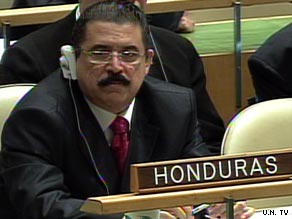
"I am going to return on Thursday because they expelled me by force, and I am going to return as always: as a citizen and as president," Zelaya said at a U.N. news conference shortly after the world body unanimously adopted a resolution that he should be restored to power.

Zelaya, speaking to the U.N. General Assembly, called the resolution historic.

"Your servant has several accusations against him in Honduras," Zelaya said. "But nobody has given me a trial. Nobody has convened a tribunal."

Meanwhile, Micheletti's provisional government said Zelaya would be arrested if he returned.

"As soon as he arrives he will be captured, as we already have the arrest warrants ready," new Foreign Minister Enrique Ortez Colindres told CNN en Español.

Zelaya would face charges of violating the constitution, corruption and drug trafficking, among others, Ortez said.

The deposed president said he would travel to Washington to attend a meeting of the Organization of American States. He also is expected to meet Tuesday evening with Tom Shannon, the top U.S. official on Latin America.

Even as Zelaya spoke at the United Nations, his opponents held a large and noisy rally in Tegucigalpa, the capital of Honduras. Crowd members waved blue and white Honduran flags and signs denouncing Zelaya.

Roberto Micheletti, the new provisional president, briefly addressed the crowd Tuesday afternoon. He vowed that the next national elections, slated for November, will be held as planned, and that a new president will be sworn in as usual in January.

Gen. Romeo Vasquez Velasquez, the top Honduran military commander who had butted heads with Zelaya, also spoke at the rally. By removing Zelaya, the armed forces were only complying with their constitutional duties, he said.

Before he spoke, the crowd chanted in support, "Armed forces! Armed forces!"

Zelaya supporters also were active Tuesday, with three major public-sector labor unions launching a general strike, a union official told CNN. About 100,000 workers joined the strike, said Oscar Garcia, vice president of the Honduran water workers union SANAA. That number could not be independently verified.

"It will be an indefinite strike," Garcia said. "We don't recognize this new government imposed by the oligarchy, and we will mount our campaign of resistance until President Manuel Zelaya is restored to power."

Also on Tuesday, the U.S. State Department said it was reviewing its aid to Honduras as it works with regional partners on a deal to restore Zelaya to power and quell political unrest in the country.

Department spokesman Ian Kelly said the U.S. was reviewing whether Zelaya's ouster met the legal definition of a "coup" before any decision was made.

"Because of the situation and the very dramatic nature of the events there and our profound concern about what's going on there, I think we're looking at a number of aspects of our cooperation," Kelly said.

The State Department has also issued a travel alert due "to the current unstable political and security situation in Honduras." The alert "recommends that American citizens defer all nonessential travel to Honduras until further notice."

In another development, two U.S. military officials in Washington confirmed to CNN that U.S. helicopters will fly over southern Honduras on a humanitarian relief mission Tuesday. The officials said there is great sensitivity to any public appearance by the U.S. military in the country.

The U.S. military also postponed some planned exercises with the Honduran military until the situation in the country settles down, according to the U.S. Southern Command.

"We have postponed certain activities," Maj. D.L. Wright, Southern Command spokesman, told CNN.

Wright said this decision would be in effect for at least two to three weeks, or "until the political situation settles."

Zelaya was overthrown early Sunday when the Honduran military arrested him and flew him to Costa Rica. Micheletti, president of the Congress, was sworn in as provisional president later Sunday.

The United Nations, OAS and most nations in the Western Hemisphere, including the United States, have condemned the ouster and demanded that Zelaya be restored to power.

The World Bank said Tuesday it would freeze funds to Honduras until the crisis is resolved, and the United States said it is reviewing its aid to the Central American nation. The U.S. joined many other nations in co-sponsoring Tuesday's U.N. resolution.

Zelaya had been at odds with the other branches of government over a referendum he wanted to hold Sunday. The Honduran Supreme Court had ruled that the referendum was illegal, and Congress had voted not to hold it.

The high court also had overturned Zelaya's dismissal of Honduras' top general, who said the military would not participate in the referendum. The court ordered that the general be reinstated immediately.

Zelaya disregarded those actions and vowed to hold the vote anyway. Micheletti also told Honduras' representatives at the United Nations and OAS to quit speaking against the new government or they immediately will be removed from their posts. They are not authorized, he said, to speak for the Honduran government.

In another development, two U.S. military officials in Washington confirmed to CNN that American helicopters will fly over southern Honduras on a humanitarian relief mission Tuesday. The officials said there is great sensitivity to any public appearance by the U.S. military in the country.

Three Black Hawk helicopters are scheduled to leave an air base at Soto Cano in Honduras and fly south to Nicaragua. They will be used to support the USNS Comfort, which is conducting a medical relief mission.
Read More

High court test for voting rights in Texas case

The community of Canyon Creek was ranchland rich with limestone and cedar trees when Jim Crow held sway in the South. The first house wasn't built until the late 1980s and not even a hint of discrimination attaches to this little slice in suburbia.

President Barack Obama won more than 48 percent of the vote in November in this overwhelmingly white community northwest of the state capital.

Yet Canyon Creek, the heart of Northwest Austin Municipal Utility District Number One, is the site of a major Supreme Court battle over the federal government's often used and most effective tool in preventing voting discrimination against minorities.

The utility district's elected five-person board manages a local park and pays down bond debt. Because it is in Texas, the board is covered by a section of the Voting Rights Act that requires approval from the Justice Department before any changes can be made in how elections are conducted.

That requirement applies to all or parts of 16 states, mostly in the South, with a history of preventing blacks, Hispanics and other minorities from voting.

The utility district is challenging that section of the law, which Congress extended in 2006 for 25 years. The Obama administration is defending it.

The Voting Rights Act, enacted in 1965, opened the polls to millions of black Americans. The law "has been the most important and transformative civil rights act in our country's history," said John Payton, director of the NAACP Legal Defense and Educational Fund.

The federal government has used the provision, known as Section 5, to "stop things that would have perverted our democracy," Payton said. His group represents Texans and organizations seeking to preserve the section.

On the other side are the utility district, an array of conservative legal groups and some Southern Republicans.

Texas and other Southern states once might have deserved to be under federal supervision, but the time for this "unparalleled federal intrusion" on a traditional power of state and local governments has passed, the utility district says in its challenge.

The justices will hear arguments in the case this coming Wednesday.

Much has changed across the South and elsewhere in the country, not least of which is Obama's election, Gregory Coleman, the district's lawyer, has told the court.

If the justices side with Canyon Creek, they could strike down Section 5 entirely, eliminating the need for any jurisdiction to seek prior approval for election changes, or tailor a narrow ruling that applies only to the utility district.

Coleman, a former Texas solicitor general, had been looking for a way to take on Section 5. In Canyon Creek, with its lack of racially charged history and unstinting compliance with the Voting Rights Act, he found a willing partner.

As recently as 2002, voters in Canyon Creek walked up Jack Steuber's driveway to choose their utility district board. Bill Ferguson won a seat on the board, then sought to hold the next election in a school rather than in a neighbor's garage.

But first the board had to seek federal clearance to change the polling location. The community got it, but Canyon Creek's board didn't understand the need to ask Washington to sign off on a change in a tiny neighborhood where there isn't a trace of minority voter discrimination.

The community has about 3,500 residents, 80 percent of whom are white, according to the 2000 census. A number of families settled in Canyon Creek for high-tech jobs. Some work at Dell Inc., whose headquarters is nearby in Round Rock.

Don Zimmerman, the utility district's vice president, spent a recent afternoon installing a security camera to scare away teenage vandals who keep ripping planks off a playground set.

"It's insulting to me to be accused of having a racial bias just because you live in Texas," said Zimmerman, an engineer.

Ferguson, 53, said, "I'm sort of embarrassed that we're still subject to this because it makes us look like dumb crackers. I don't think it's appropriate anymore."

Resounding majorities of Democrats and Republicans in Congress, however, thought it was necessary when they voted in 2006 to extend the advance approval requirement for 25 more years. President George W. Bush, a Texan and a Republican, signed the measure into law.

"Today, we renew a bill that helped bring a community on the margins into the life of American democracy," Bush said at the signing ceremony in July 2006. "My administration will vigorously enforce the provisions of this law, and we will defend it in court."

A few Republicans have raised their voice in opposition to the extension of the law, which otherwise would have expired in 2007. Among them are Republican Govs. Sonny Perdue of Georgia and Bob Riley of Alabama.

Their states, the governors said, have worked hard to eradicate the government-sponsored discrimination that resulted in federal supervision. "Georgia has earned the right to be free" of asking the federal government to bless election changes, Perdue said. In Alabama, blacks and whites register and vote in similar proportions, Riley said.

Other numbers suggest, as Justice Anthony Kennedy said in a recent court case involving a different section of the Voting Rights Act, "racial discrimination and racially polarized voting are not ancient history." In Alabama, Louisiana and Mississippi _ all of which must submit proposed election changes for approval _ less than 15 percent of white voters chose Obama.

Evidence amassed at congressional hearings showed that hundreds of discriminatory proposals were rejected by the Justice Department or withdrawn when government lawyers raised questions.

The Supreme Court has upheld the advance approval requirement on four occasions before now. The outcome this time may be no different, but the recent additions of Chief Justice John Roberts and Justice Samuel Alito have given hope to the law's opponents.

Roberts, in particular, has in several cases opposed the continuing use of race, once lamenting the "sordid business" of taking race into account to draw congressional districts.

In Canyon Creek, residents seem to care more about their tax squabbles with the Austin city government than the voting rights dispute, according to Ferguson, the board member.

And not all the utility district's leaders believe issue before the high court has run its course. Chris Bowers, 40, was elected last May on a platform that questioned why this was even Canyon Creek's fight. Bowers believes his victory shows many agree with him.

"I think it's dangerous to be using the government entity which has this narrow focus of paying off ... bonds" to challenge a federal law, Bowers said. "This really seems out of scope."

Supreme Court Writer Mark Sherman reported from Washington.

Read More

CNN: Obama pleased with NATO allies' pledges of Afghan support


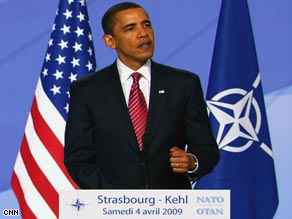
STRASBOURG, France (CNN) -- President Obama hailed the NATO summit in Europe on Saturday, calling the meeting "very productive" and praising the alliance's commitment to the fight in Afghanistan.Today I'm confident that we took a substantial step forward to renewing our alliance to meet the challenges of our time," said Obama.

Speaking to reporters as demonstrators protested against more involvement in Afghanistan, Obama said he was "pleased NATO allies pledged their strong and unanimous support" for America's new strategy in Afghanistan -- which calls for more troops, trainers and civilian workers.

He said America's NATO allies and partners have agreed to supply more combat troops to help shore up security during Afghan elections later this year.

More trainers have also been pledged for the police and army, and an expansion of a trust fund to help sustain Afghan security forces is in the works. Obama talked about achieving an increase in non-military assistance, such as doctors, engineers, educators and agricultural specialists.

America's NATO allies are pledging 5,000 more troops: 3,000 for the upcoming Afghan election security, 1,400 to 2,000 troops embedded with Afghan soldiers, and 400 police trainers.

This is apart from the 17,000 more combat troops and 4,000 trainers Obama recently committed.

"These commitments have troops, trainers and civilians represent a strong down payment on the future of our mission in Afghanistan and on the future of NATO."

Obama had been pushing for more NATO troops in Afghanistan, and he was asked whether he thought he got enough combat troops.

"This was not a pledging conference, and yet, we already received the kinds of commitments that historically you don't see at a conference like this," he said.

"This was at a summit that was designed to discuss strategy as opposed to attract pledges, and I think it's an indication of the fact that this alliance is committed to achieving the focused goals that we have set out in Afghanistan."

Along with the focus on the ground in Afghanistan, Obama said the United States and his allies want to help strengthen Pakistan's ability to fight al Qaeda and "deliver goods and services and a better life for its people."

Obama thanked French President Nicolas Sarkozy and German Chancellor Angela Merkel for hosting the conference.

"I should add that not only were they gracious hosts, but the commitment that they made with respect to Afghanistan, indicate the seriousness of purpose with which they are approaching the NATO challenge and our mission in Afghanistan in particular," Obama said.

Also at the end of the summit, it was announced that Danish Prime Minister Anders Fogh Rasmussen had been named the alliance's new secretary-general. The decision was unanimous.

Earlier in the day, the NATO leaders held symbolic ceremonies to mark France's return as a full NATO member and to remember those who have died in NATO-led missions during the alliance's 60-year history.

The leaders gathered on a footbridge over the Rhine River separating France and Germany.

Merkel and the other leaders walked to the middle from the German side of the bridge. There they met French President Sarkozy and all shook hands, symbolizing France's re-entry in NATO's military command more than four decades after it left.

Eight jets from the Patrouille Acrobatique de France, an aerial display team, flew overhead trailing the NATO colors of blue and white.

The group then walked onto the French side of the bridge for a solemn ceremony to honor the men and women in uniform who have died in NATO missions and operations over the years.

Surrounded by the flags of all 28 NATO member states, a lone military bugler played a tune before the place fell silent in memory of the fallen.

The NATO alliance has grown at the summit to include two new members, Albania and Croatia. Obama noted that both have contributed troops to the Afghan mission.

Noting that Saturday marked NATO's 60th birthday, Obama said, "It's a measure of our vitality that we are still welcoming new members."

Saturday morning's ceremony over the Rhine was briefly delayed because Italian Prime Minister Silvio Berlusconi was deep in conversation on his mobile phone. The other NATO leaders eventually went on without him, and he was absent for both ceremonies.

Berlusconi rejoined them in time for a group photo after the moment of silence.

After the conclusion of the summit Saturday, Obama plans to head to Prague, in the Czech Republic, the current president of the European Union.

In Prague, Obama plans to make a speech on proliferation and ridding the world of nuclear weapons. As many as 30,000 people were expected to turn out for the speech, the first major foreign policy address of Obama's presidency.
Read More

Cuba: US embargo 'still standing' despite new law

Cuba's state-controlled media on Monday downplayed eased U.S. rules on family ties with Cuba, calling the measure a defeat for the communist government's foes that still left Washington's 47-year-old trade embargo intact.

The article in the Communist Party newspaper Granma was the first official mention of the Cuba clauses in a package signed into law by President Barack Obama on March 11 _ nearly two weeks prior.

The law rolled back limits on family travel and remittances imposed by the Bush Administration, effectively allowing Americans with relatives in Cuba to visit once a year, stay as long as they wish and spend up to $179 a day. The changes only remain in effect until the fiscal year ends Sept. 30.

Granma said the changes "represent the first setback for the anti-Cuban mafia and its representatives in Congress," but added that "in practice, they don't affect the siege that successive administrations have maintained against our people."

U.S. law still bars most trade with and travel to Cuba.

"These steps don't restore the rights of Cuban residents of the United States to travel freely to Cuba or approve the rights of citizens of that country to visit a neighboring island," it said.

President Barack Obama has said he is open to talks with Cuban leaders, though he said he does not yet favor lifting the U.S. embargo. Cuban officials have sometimes criticized Obama, but have been far less hostile than they were toward ex-President George W. Bush.

Read More